Showing posts with label Reptiles. Show all posts

Iguana Nutrition: Feeding Your Iguana


Iguana diets are highly debated and controversial subjects as far as what to feed and how much. Part of the reason is because there is still so much to learn about them before we can say we have perfected their dietary needs, however we know enough to have a conversation and to make sure your iguana is getting the best nutrition you as its caretaker can provide. 

PLANTS, BUGS, BOTH?

First thing is first, green iguanas are strict herbivores. No one should argue me on this, because it’s science. Their bodies are not properly prepared to break down and utilize animal protein. So with that being said, please only feed your green iguanas vegetation - NO BUGS! 


WATER

You should always have a bowl of water available to your iguana, separate from their tub of water for soaking and possibly defecating. Very rarely will you see them drink, and that is ok, but you should always have water provided. A majority of the water they receive will come from their food, but also from the high humidity in their enclosure. A well hydrated iguana is a healthy iguana! Make sure your iguana has access to clean fresh water every day. Dirty old bacteria infected water is unsanitary and can lead to health concerns. 

FOOD 

Like water, make sure your iguana has access to new fresh meal at every feeding. No one wants to eat a salad that has been left out for a day. 

HOW OFTEN?

The general consensus is that green iguanas should be fed daily. Some people will say adults can be fed every other day or so, but ideally you want to offer your iguana fresh food every single day. 

HOW MUCH?

This is the easy part of feeding iguanas - let the iguana tell you how much. If you feed your iguana and come back to an empty dish, odds are you did not put out enough. You want there to be leftover food at the end of the day. This lets you know that your iguana got its’ fill and isn’t still hungry. However, if you see that during the day your iguanas dish is empty, you can certainly give them more food! There’s no problem feeding multiple times a day, since iguanas will only eat until they are comfortable. 

WHEN TO FEED?

In my opinion, earlier in the day is better. I know many other iguana keepers will agree with me on this as well. This will give the iguana ample time to sit and bask in its basking light and UVB to digest its food properly. Giving a little bit of food in the evening is fine, you just don’t want to give the iguana the majority of its food in the evening before it goes to bed for the night. 

THE BASICS OF FEEDING

Here are the basic yet important aspects of feeding your iguana:
  • Give a Variety
  • Prioritize the 2:1 Calcium to phosphorus ratio
  • A good diet isn’t complete without good UVB exposure and proper temperatures

2:1 CALCIUM TO PHOSPHORUS RATIO

This ratio is perhaps the most important thing to keep in mind when feeding your iguana. Calcium is extremely important to keep an iguana strong and healthy, and a lack thereof can cause common health problems such as metabolic bone disease. 


Phosphorous is an important part of an iguana’s diet as well, put too much phosphorus can lead to problems for your iguana, so you always want to aim for a 2:1 ratio. 

Now you are probably wondering how to tell the ratio of what you are feeding. The best way to check the ratios of different foods is to consult the Green Iguana Societies food chart. 


WHAT TO FEED

Your iguana needs a combination of greens, vegetables, fruits, and supplements. We will talk about supplementation after we talk about what to feed your iguana. 

The main rule of thumb is to compose your iguana's diet of 45% greens 45% veggies and 10% fruit, or as I like to say 50/50 greens and veggies with a little bit of fruit. You can also offer a small amount of grain based food once in a while as a treat, such as whole wheat bread or cooked rice/pasta, although I never do, because Arcadius has no interest. 

Remember to offer a variety of foods - no one likes to eat the same meal every. Single. Day. 

Greens

My go to greens are collard greens, turnip greens, dandelion greens, watercress, and mustard greens. These are all higher in calcium than phosphorus, and considered a staple green. They make an extremely nutritious and delicious salad when you pick a couple to mix together. 

Other good greens to mix in with your staples are escarole, bok choy, and endive.


Vegetables

My go-to veggies are squash (butternut, acorn, and kabocha), green beans, peas, and parsnip. These are great staple veggies to feed your iguana. 


Other good veggies to mix in on occasion or with your staple veggies are asparagus, mushrooms, sweet potatoes, zucchini, yellow squash and carrots. Bell peppers are an excellent taste and color enhancer for you Iggy salads, and I almost always add a little to Arcadius’ salads. 


Fruits

My go to fruits are mangoes hands down. Mangoes are also known as iguana crack, because iggys absolutely love them. Cactus leaves (prickly pear), mangoes, and papaya are some of the best staple fruits you can give your iguana.  

Other good fruits to feed on occasion are various berries, grapes, bananas, and melons. Feeding watermelon is a great way to increase your iguana’s water intake, and that was one of the main treats Arcadius was fed when he was on the mend from his metabolic bone disease, because we wanted to up his water intake. 


Extra Special Treats

Want to really get on your iguanas good side? Offer flowers. You have to do some research to make sure the flowers you offer are iguana safe, and you always want to be cautious that your flowers aren’t treated with things such as pesticides. 

Some iguana favorite flowers are dandelions, nasturtiums, dahlias, and hibiscus. 

Foods you won’t catch me feeding

Now that I’ve told you all of the food items I feed to Arcadius, I’m going to tell you what foods you won’t catch me feeding him - the first being lettuces, such as iceberg or romaine. Now there aren’t harmful to your iguana by any means, so many people will feed these to their reptiles as an additional green to mix in to add variety. The problem I have with them is that they have little to no nutritional value, so for me it’s not worth feeding to my iguana, because I have so many other nutritional greens to feed him. 

The rest of the foods I won’t feed Arcadius have more to do with oxalates and goitrogens. The 2:1 ratio is important to keep in mind, but so is keeping an eye on how much oxalates and goitrogens your iguana is taking in. 

Oxalates can sometimes bind to calcium, making it so the iguanas body can’t utilize it, meanwhile goitrogens can bind iodine, leading to hypothyroidism. These two things are common in many foods, some of which I will not feed my iguana. They are the following - 
Kale, Spinach, beets, broccoli, Brussel sprouts, cabbage, carrots, and cauliflower.

Many people will feed their reptiles these foods as a way to add variety, because in an overall healthy diet, adding these as a treat should not do any hard, however in my opinion it isn’t worth it. Many fruits will be high in either goitrogens or oxalates, so I prefer to be more lenient with fruit since it’s a special treat, and then offer him a variety of staple and very healthy greens and veggies. 

(I also may be biased because it was a diet of spinach, kale, and broccoli that contributed to Arcadius having severe metabolic bone disease). 

Again, for a full list of all the food possibilities, their nutritional value, and how to prepare, visit the Green Iguana Societies Food Chart.

SUPPLEMENTATION

There are three main types of supplements you should provide your iguana with:
Calcium without D3
·         As we stated earlier, calcium is a very important part of an iguana's diet, so it’s a good idea to add a supplemental calcium to your pet’s diet to insure they are getting enough. I say without D3, because your iguana’s body synthesizes D3 from UVB exposure, and too much D3 can cause problems such as organ mineralization. 
·         Repti Calcium from Zoo Med is a good powdered source.
·         Baby iguanas should get a pinch of calcium daily, and young iguanas should get a pinch almost every day.
·         An adult iguana will need supplementation much less.
·         Supplement calcium more frequently for gravid females or iguanas suffering from MBD. 
·          
Multivitamin
·         Just like people, iguanas need a multivitamin supplement to assist their body with getting any vitamins they might not be getting enough of in their diet. This just helps insure an extra healthy iguana. 
·         Herpvite multivitamins from rep-cal is a great all natural multivitamin supplement. 
·         Add a pinch for a young iguana every other feeding, and a pinch for adults once or twice a week. 
Protein
·         Protein is an important part of anyone's diet, but since green iguanas are strict herbivores, they need plant protein - the best supplement for this is alfalfa. Sometimes you can find shredded alfalfa in small mammal departments, but you can also crush alfalfa tablets that can be found in most pharmacies. 
·         I add alfalfa to Arcadius’ meal every other feeding. 

Visit Anapsid for a supplementation schedule by clicking HERE.


So there you have it! An overall guide to iguana nutrition and how to feed your iguana! If you have any questions please leave a comment, or you can contact me via email or on any social media, such as Instagram and twitter.

Happy Salad Making!


DIY Iguana Enclosure


Large reptiles are becoming super popular in the reptile industry, but large reptile enclosures are bank breakers. 

I’m finding that this is a common problem in casual reptile keeping that is leading to poor animal husbandry and therefore poor reptile health.

So what do you do when you want a large reptile, but cant afford a large enclosure? YOU DIY IT!
I’m going to walk you through how we built my iguana enclosure.

I’d like to start off by saying I would have liked to make it bigger, but this enclosure had to travel to college with me and it is plenty for his size right now.  

Materials:
  • A heavy duty HDX shelving unit  - $60 to just over $100 depending on the size you want
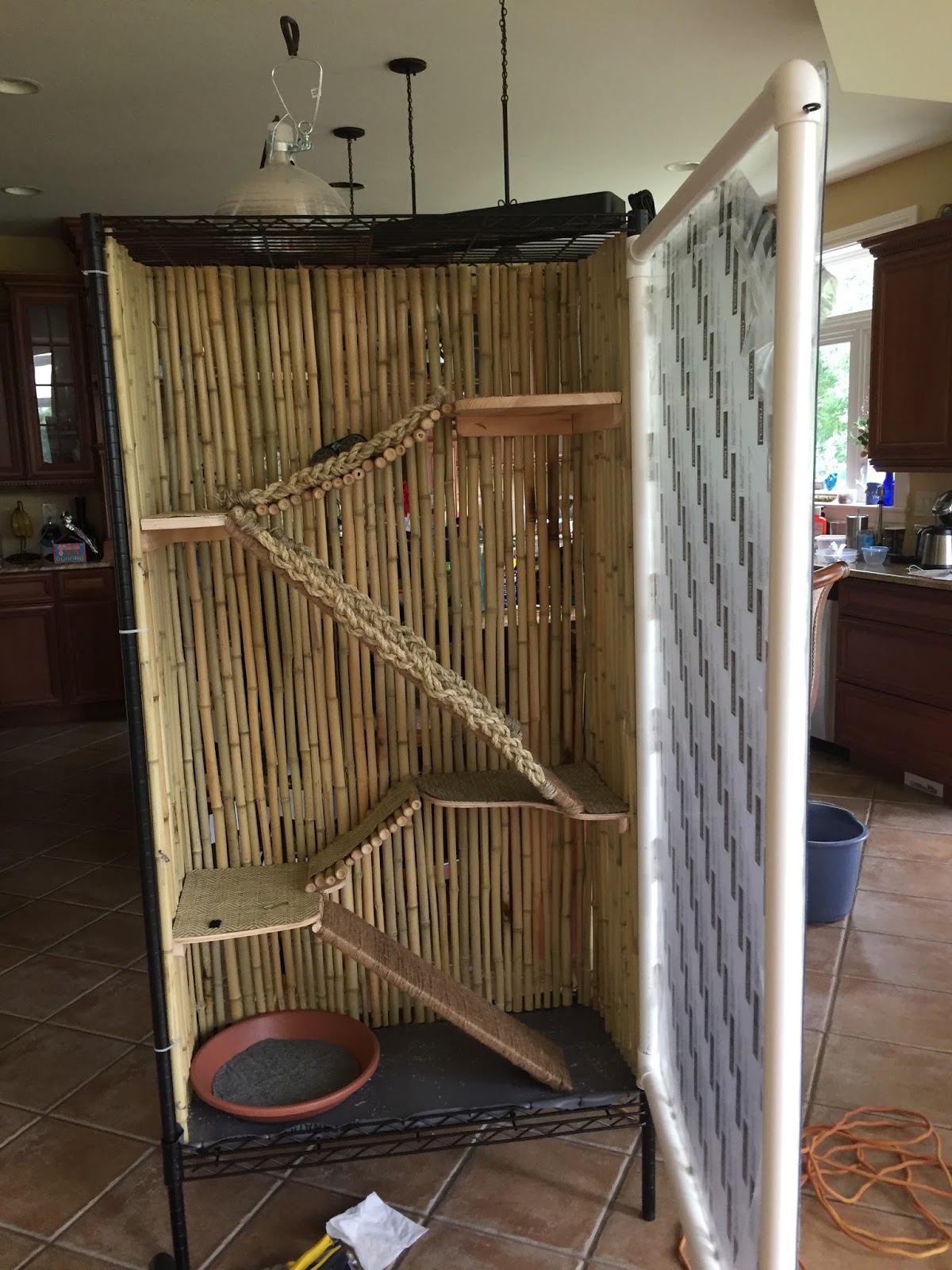
  • Fencing to go around the shelving unit - we used Backyard X-Scapes bamboo fencing from home depot ($84) because we liked the thicker bamboo. They do having reed fencing that looks just as nice for $26.
  • Materials for inside - Branches, wood for shelves, ramps, etc.
  • PVC to create a door - 2 Tees, 2 elbows, 4 straight pieces. Make sure they are wide enough to fit over the corner pole from the shelving. 
  • Plexi Glass - make sure its big enough for your door. We bought this after we had the door assembled. We also bought Lexan, so it was a little more expensive- BUT really good quality. You could use some sort of mesh if you live in a humid environment. We went for the glass because it looks nice and helps hold in humidity. 
  • Landscape fabric - this will act as a base for the enclosure. 
  • Garden liner and tile for the base tray. 
  • Brackets and screws
  • ZIP TIES
  • Whatever decor you want - We hit up Michaels and Jo-Anns with those good coupons

 Instructions:


  1.  CUTTING
    • Figure out how tall your shelving is and how long the fencing needs to me and then make the appropriate cuts. 
    • Measure and make cuts to your pvc to create your door
    • Cut the landscape fabric to fit one of the shelves.
  2. BUILD
    • Take one of your long pvc poles and attach the two Tee pieces to each end.
    • You are only going to use two of the shelves from the unit for this project. Take one shelve and flip it upside down for the base. 
    • Before you put the shelf on to create the top of the enclosure, slide the pvc that will connect the door to the enclosure over the corner pole, and situate the fencing (if it is going inside like how we did the bamboo).
    • After you piece it all together, use zip ties to attach the fencing and the landscape fabric to the shelving unit. 
  3. DOOR
    • Now you can finish assembling your door frame.
  4. GLASS
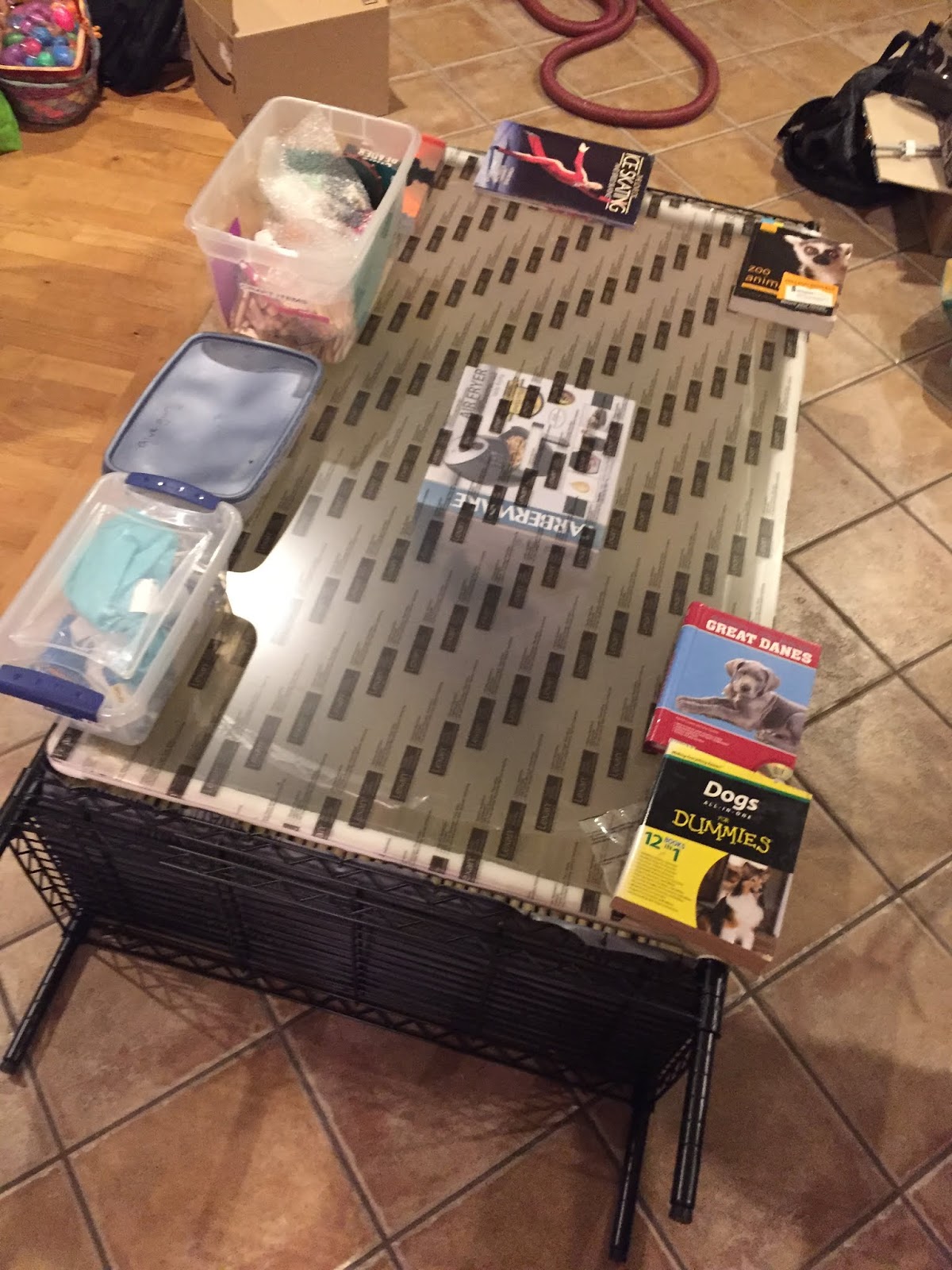
    • Go ahead and lay your enclosure down, and using silicone, glue the glass to the pvc.
    • You will want heavy items to hold the glass down while it dries. 
    • We did this step at night, so it could sit while we slept. This way we weren't losing valuable building time!
  5. INTERIOR DESINING
    • This was the fun part. Now you get to design the interior layout of your enclosure
    • I highly recommend drawing your idea, and for any shelves, draw them and cut them out of paper so you can visualize what it will actually look like in the enclosure. Then you can use it as a stencil on your wood before cutting out your shelf. 
    • With a deeper enclosure, it would be really easy to just add a bunch of branches and call it a day, but because I was building for a physically deformed and injured iguana, we had to handicap it with lots of ramps. 
    • to secure the shelves, we screwed the shelves to smaller blocks of wood, which we secured to the fencing with a bracket. 
    • For better looks and ease of climbing, I wrapped the ramps in twine and used a thicker rope to braid a "railing" along the longest one. 
    • **** Be sure to plan out where your lights will go!*****


    • For the base, we created a removable tray. We glued two pieces of tile to a rubber mat, and then added garden liner around the edges. This was if he were to spill water or go to the bathroom, it wouldn't get soaked up by the bamboo. 


          6. LIGHTS, FLORALS, ETC

    • We loaded the enclosure with zip ties!
    • Your lights can go on top of the enclosure, but you may want lights in the enclosure depending on how you style the interior.
    • Make sure you provide vegetation that allows your iguana to hide and feel safe!
    • You can zip tie a plastic table cloth or shower curtain to the enclosure to help hold in humidity 
    • Don't forget some sort of "pool" for your iguana!  

     If you have any additional questions don't be afraid to get in contact with me ! And if you custom built your own enclosures definitely send me pictures! I'd love to see them ! :) 

    8 Musts to Beating Metabolic Bone Disease


    How does MBD Work?


    There’s no doubt that MBD can be a confusing thing to understand, so I want to try and explain things as simple as possible - so simple that I was finally able to truly understand it.
    There are various causes to how a reptile gets MBD. One is the reptile is getting an inadequate ratio of calcium to phosphorus in their diet. They should be getting a ratio of 2:1, and if they don’t get enough calcium, their body pulls it from the bones instead = the bones become weak and subject to breakage.

    Another cause is the lack of UVB exposure. UVB synthesizes vitamin D3 so that the body can use it → Vitamin D3 is needed in order for the body to absorb calcium.
    So basically there are four main things to think about:

               Calcium
               Phosphorous
               UVB
               Vitamin D3

    Of course like anything, there are several other causes, but they more or less link back to these MAIN causes, and by simply making sure your iguana has the proper diet and proper habitat, the odds will be in your iguanas favor.
    Now back to the list that y’all came here for….

    We have all seen those heartbreaking cases of Metabolic bone disease. If you or someone you know is dealing with an iguana with serve MBD, this is what I recommend to you:

     1. Keep it positive, but keep it realistic.

    I knew iguanas rarely come back when they are that far gone. I kept telling myself that he could get better if I did everything right and didn't give up on him, but I also made sure not to forget that if it went on long enough, there would come a point where I’d need to let go.

    2.            Soak and don't get discouraged!

    This is especially for you iguana people dealing with the inability to poop, which mine was. Because of nerve and spinal damage, he was unable to control that end of his body.

    I gave Arcadius a nice long soak 1-2 times a day for weeks. There were days I thought what's the point, because they never seemed to do anything, but who am I to say they didn't help. I did it, and my iguana turned around - so it doesn't hurt to try!

    3.            CALCIUM / PROPER DIET

    Pay attention to what you are feeding your pet! The Green Iguana Society has a great chart with all the foods listed and their calcium to phosphorus ratio. Ideally you want to feed them foods with a 2:1 (ca:p) ratio, but when you are battling severe MBD definitely offer those foods higher in calcium!

    Your greens can be a great source of calcium, so during this time I did 60% greens, 40% veggies, and a tiny treat of fruit. Making sure your iggy gets protein during this time is important too. A good source of this is alfalfa. If you don’t have this available to you, you can buy the alfalfa treats you would find for rabbits and shred them into a powder like consistency. Then you just have to sprinkle it on your iggys food!

    You can also use a calcium supplement, but try to find one without D3. Your iggy gets D3 from its UVB, and too much D3 can cause other health problems.


    This is a post recovery meal. I do not recommend this much fruit for someone
    going through MBD. He was just getting spoiled this day. 

    My top recommendations:

    ·         Collard greens (!!!!), mixed with turnip greens, mustard greens, watercress, and/or dandelion greens. (Always collard greens).
    ·         Green beans, butternut squash, acorn squash,
    ·         Papaya and mango
    ·         Alfalfa
                           
                            Stay away from treats and occasional foods during this time.

    4.            UVB

    Make sure your iggy has UVB exposure, and that it is the correct distance away from the bulb to be getting what it requires. Most importantly, get a good UVB bulb!!! This means spending some $$$, but it’s  worth it if your iguana is healthy again right?

    I recommend a mega ray - this bulb is heat and UVB combined AND has a long and wide beam for maximum efficiency. Also highly popular, are Arcadia lights and zoo med’s powersun lights (these can be found in petsmarts).

    5.            Patience

    Your baby won’t heal overnight, or even in a week. Reptiles can take months to heal, so just be patient while their body does its’ thing.

    6.            Always seek vet help

    Some vets know more about reptiles than others, but it doesn't hurt to try and get assistance from them. In my case, I was not all that impressed with our vets enclosure set up, but he knew how to manually poop an iguana and that was all I really needed.

    He was able to show us how to do it at home, and I believe this manual pooping is really what helped his body get back on track. Plus, he wasn’t full of sh** in the healing process (LOL) !

    7.            Handicap everything!

    Take away any obstacles that could potentially cause more injuries or damage to your iguana until the healing process is well underway.

    When this all happened he was temporarily in a 20 gallon tank. We put a towel down to not only pad everything, but to give him something to grab on to with his front legs, since he couldn’t use his back legs.  


    Arcadius’ enclosure we built is all ramps, because he was in the middle of recovery when we built it. His enclosure at my parent’s house now has branches and vines, because he is stronger now and can handle it better than before, but he is still tipsy on them.


    IF YOUR IGUANA ISN’T DEFECATING ON ITS’ OWN

    8. Increase water

    This means making sure the humidity is up and adding water filled substances to their diets.

    A good source of water is cucumber and watermelon. Also, getting an eye dropper to physically give them water to drink is a good idea. Sometimes we created fruit infused water to encourage him to drink the water.

    And as I mentioned before - baths! Lots and lots of baths! Iguanas typically go to the bathroom in the water, so this could be another form of encouragement.


    And as always, don’t let your iguana go too long without defecating. A reptile vet should be able to help manually poop your iguana. If they are nice like ours, they’ll have you come back every couple of days to repeat the process (until they think you have a lost cause and show you how to do it yourself so you stop throwing money at them).

    *Side note: I do not recommend pooping your iguanas yourself, unless it comes down to it and you have vet assistance the first time around. That is a last resort situation and it takes two people*


    It is important to remember, that your iguana may not go back to its totally healthy able iguana self. Arcadius suffered spinal and nerve damage, so he will forever have a curve in his spine and he can’t use his hind legs as well as a healthy iguana can. This being said, he is pooping on his own and living a completely spoiled life full of love and happiness! All you can do for them during these hard times are give your full love and support!


    I’m hoping for the best for all of you MBD fighters out there!

    Do you have any experience with MBD or any questions? I’d love to hear from you!